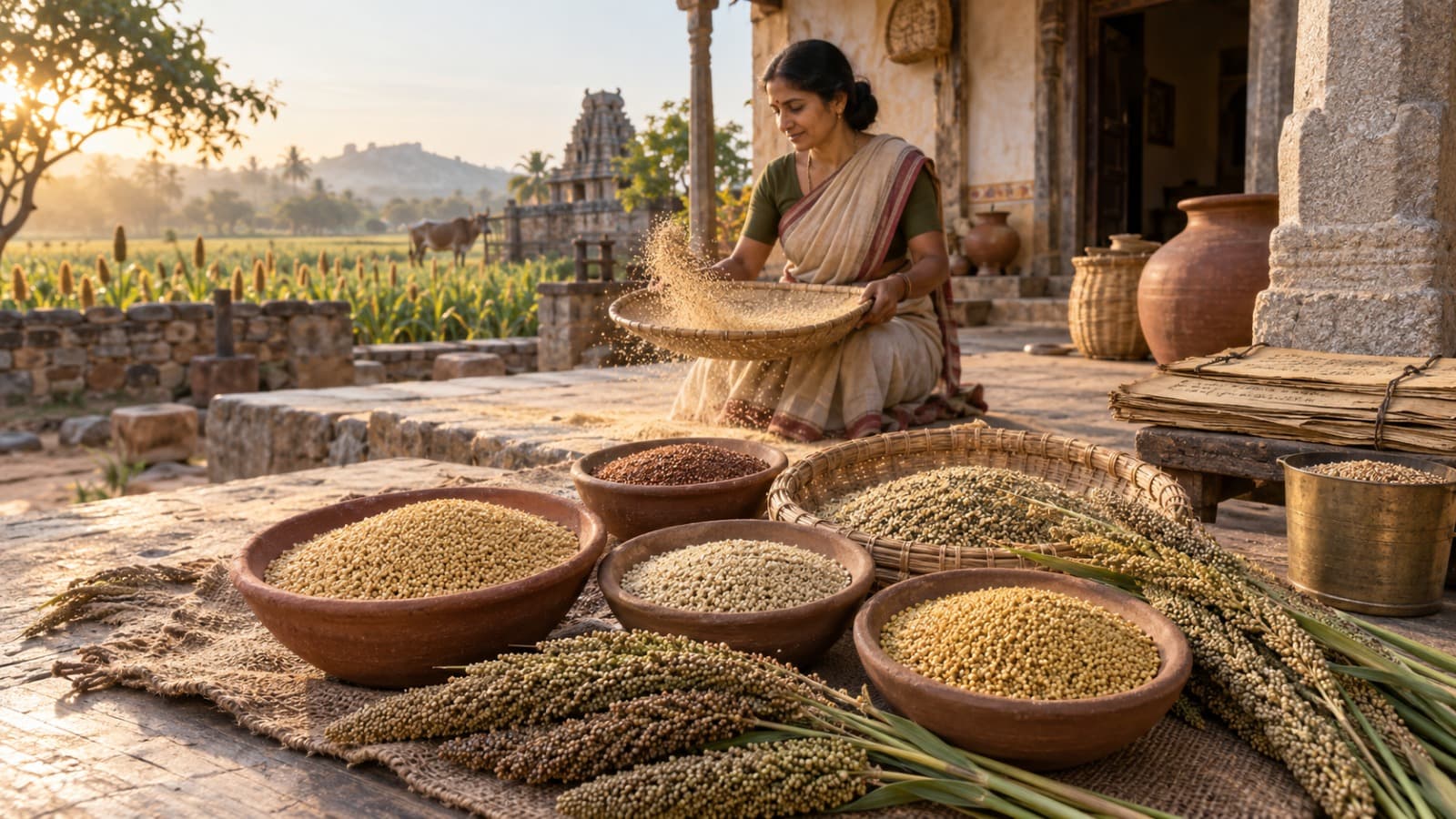
Millets are a family of small-grained cereal crops that have been cultivated and eaten for thousands of years. They belong to the grass family, but “millets” is not the name of one single grain. It is a broad group containing several different species, each with its own appearance, flavour, growing conditions and nutritional profile.
In India, the best-known millets include finger millet or ragi, pearl millet or bajra, and sorghum or jowar. The smaller millets include foxtail, little, kodo, barnyard and proso millet. Browntop millet is another small millet receiving growing attention. Buckwheat and amaranth are often called pseudo-millets because they are used like cereals but botanically belong to different plant families.
This diversity matters. There is no single “millet nutrition profile.” Protein, fibre, minerals and other components vary between species, varieties and growing conditions. FAO notes that whole millets can provide minerals, dietary fibre, vitamins and protein, with differences between millet types.
Millets are also naturally gluten-free. That makes them useful ingredients for people who choose or need gluten-free foods, although packaged foods still need appropriate controls against cross-contact if a gluten-free claim is made.
Perhaps the most interesting feature of millets is their adaptability. Many are suited to dryland agriculture and can grow under challenging conditions with comparatively low external inputs.
So, when someone says “millets,” think plural—not singular. They are a family of grains offering a wide range of tastes, textures, traditional foods and modern applications.
The easiest way to discover them is to start with one grain, cook it simply, and gradually explore the rest.
